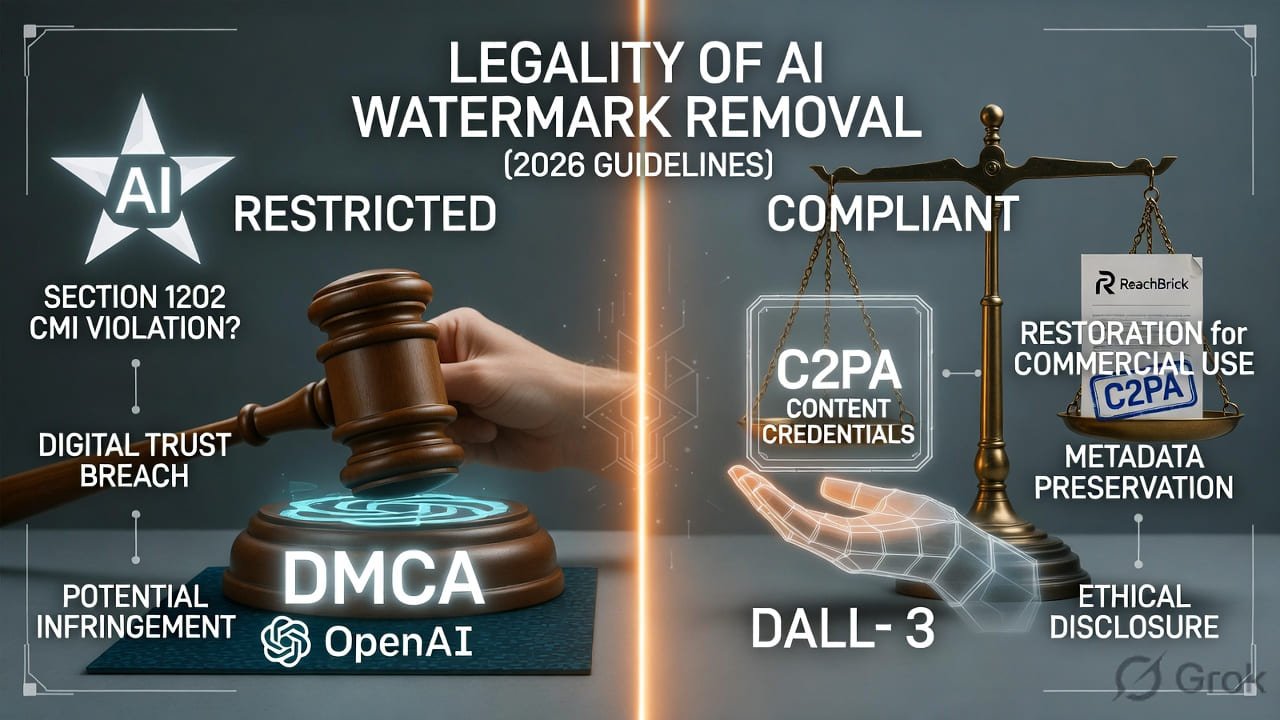
Introduction: The Great AI Attribution Debate
As generative artificial intelligence matures in 2026, the lines between “AI-generated” and “Human-made” are blurring. To maintain transparency, tech giants like Google, OpenAI, and xAI have implemented mandatory watermarking. But as a creator, you might find these logos intrusive for your professional portfolio. This raises a critical, million-dollar question: Is it legal to remove an AI-generated watermark?
In this comprehensive legal and ethical guide, we break down the complexities of digital attribution, the role of ReachBrick AI, and how you can stay compliant while maintaining a clean aesthetic.
1. The Legal Framework: Understanding DMCA Section 1202
In the United States and many international jurisdictions, the Digital Millennium Copyright Act (DMCA) is the governing law. Section 1202 specifically deals with “Copyright Management Information” (CMI).
CMI includes titles, artist names, and—most importantly—watermarks.
The Law vs. AI
Technically, removing a watermark from a photo you do not own is a violation. However, AI-generated images sit in a unique “gray area.” Under current US Copyright Office rulings, AI-generated images that lack “significant human authorship” cannot be copyrighted by the AI company itself.
The ReachBrick Perspective: If you are the one who provided the prompt and “created” the image, you often hold a level of usage right that allows for personal modification.
2. Terms of Service (ToS): The Contract Between You and the AI
While the law might be evolving, the Terms of Service of the platform you use (Gemini, ChatGPT, Grok) are very clear.
- ChatGPT (OpenAI): Generally allows commercial use for paid subscribers, but they encourage (and sometimes require) transparency about AI’s role.
- Google Gemini: Focuses heavily on the C2PA standard, where metadata is embedded into the file.
- Grok: Offers more freedom but expects users to follow X.com’s media policies.
Removing a visual watermark is often a matter of Design Preference, but removing the internal metadata (C2PA) is where things get technically sensitive.
3. The Ethical Side: Why Transparency Still Matters
Just because you can remove a watermark using a tool like ReachBrick AI, doesn’t always mean you should hide the fact that AI was used. In 2026, “Digital Trust” is a currency.
When it is 100% Okay to Remove Watermarks:
- Professional Presentations: A clean slide deck looks better without a “Star” logo in the corner.
- Virtual Staging: Real estate agents cleaning up AI-staged rooms for better client visualization.
- Graphic Design Backgrounds: When the AI image is just one layer in a larger, human-made masterpiece.
When You Should Disclose AI Use:
- Photojournalism: Altering reality in news is a major ethical breach.
- Political Advertising: Most countries now require a “Made with AI” label on political content.
4. How ReachBrick AI Ensures Ethical Restoration
At ReachBrick, we don’t just provide a tool; we provide a Professional Utility. Our technology, specifically Reverse Alpha Blending, is designed for:
- Restoration, not Deception: We help you restore the pixels that were covered by an intrusive logo.
- Local Processing: By keeping the processing on your browser, we ensure that your creative choices remain private.
5. C2PA and the Future of “Invisible” Watermarking
The future is moving toward Steganography. Even if you use ReachBrick to remove the visible star or text, the C2PA Metadata usually remains in the file’s header. This is a win-win:
- The image looks clean and professional to the human eye.
- The image remains identifiable as AI to social media algorithms (like Instagram or X).
This balance is exactly what ReachBrick advocates for—aesthetic perfection without breaking the digital chain of trust.
6. Frequently Asked Questions (FAQ)
Q1: Can I get sued for removing a DALL-E 3 watermark?
If you own the account that generated the image and are using it for your own business, a lawsuit is highly unlikely. However, using it to impersonate a human artist’s style is a different legal matter.
Q2: Does ReachBrick remove invisible metadata?
No. ReachBrick is a Visual Restoration Tool. We fix the pixels you see. We do not strip the underlying security metadata, which helps you stay compliant with platform policies.
Conclusion: Use the Power Responsibly
ReachBrick AI was founded on the principle of giving creators control over their visual output. A watermark is a “Brick” in the wall of your creativity. We help you reach over that wall.
Legal compliance + Aesthetic clarity = Professional success.