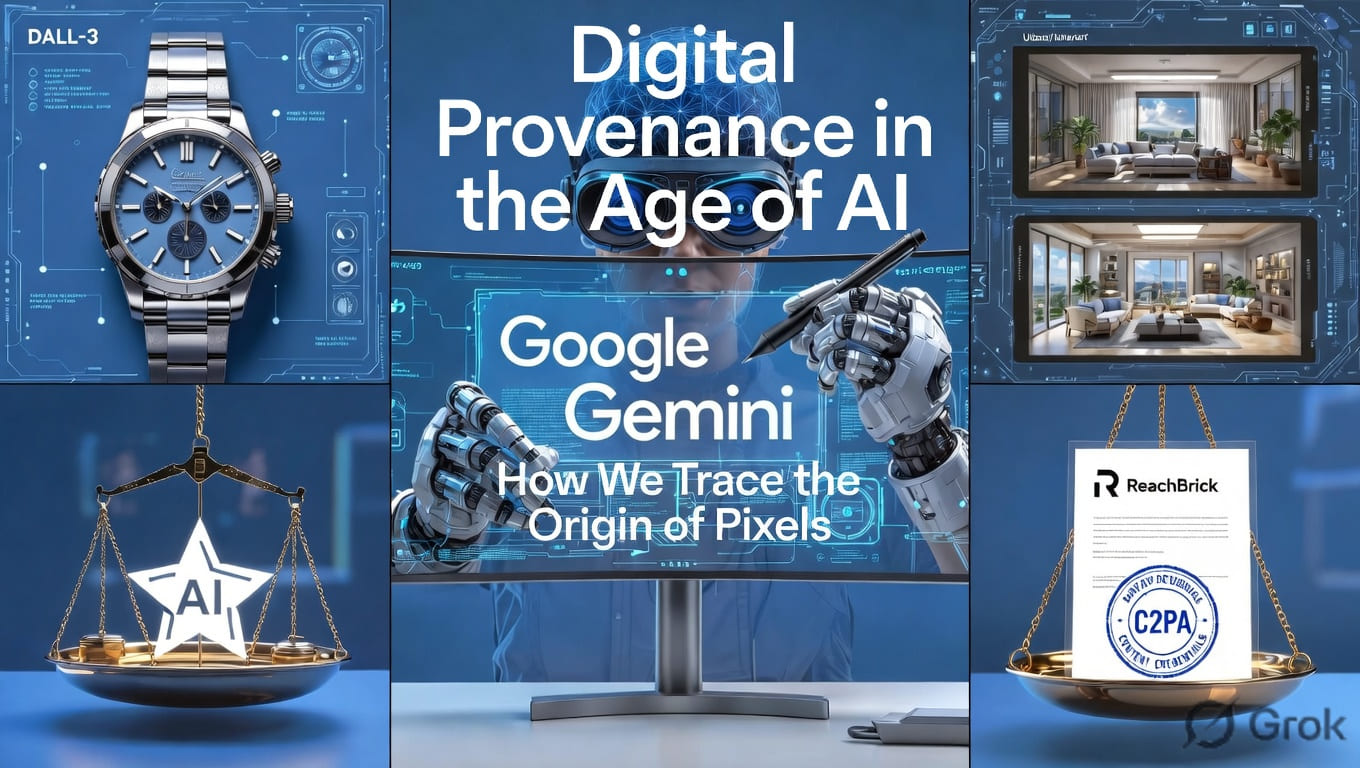
Introduction: The Crisis of Truth in 2026
In the mid-2020s, the internet reached a tipping point. As generative AI models like Gemini and DALL-E became capable of producing photorealistic imagery in seconds, the fundamental question changed from “Is this a good photo?” to “Is this even a photo?”
This era is defined by the “Crisis of Truth.” When pixels are so easily manipulated, how do we know where they came from? The answer lies in a field of digital science known as Digital Provenance.
Provenance—a term traditionally used in the world of fine art to trace the history of a painting—has now become the backbone of digital security. In this deep dive, we explore the intricate science of tracing pixels, the role of invisible watermarks, and the global standards designed to protect human creativity.
1. The Anatomy of Digital Provenance
Digital provenance is more than just a timestamp. it is a chronological record of an image’s life cycle—from its birth (generation or capture) to its current state.
The Layers of Proof
Every digital image today consists of three layers that tell its story:
- Visual Data: The actual pixels we see (RGB values).
- EXIF/IPTC Metadata: Basic info like the camera model, date, and GPS coordinates.
- Cryptographic Signatures: The modern “Gold Standard” of provenance that links the image to its creator (human or AI) using digital keys.
2. The Rise of the C2PA Standard
To combat the spread of deepfakes and misinformation, the Coalition for Content Provenance and Authenticity (C2PA) was formed. Adobe, Microsoft, Google, and Intel joined forces to create a standard that acts like a “Nutrition Label” for digital content.
How it Works: The “Manifesto”
When an image is generated by a modern AI, the engine attaches a “Manifesto” to the file. This is not a visible watermark, but a piece of code that says:
- Source: AI-Generated.
- Model: DALL-E 3 (OpenAI).
- Edits: Cropped, Color-Corrected, or Restored.
This data is signed with a private cryptographic key, making it almost impossible to forge without breaking the file’s integrity.
3. The Science of Steganography: Invisible Watermarking
While visible logos (like stars or text) are the most common way for users to identify AI images, scientists prefer Steganography. This is the art of hiding a message in plain sight.
High-Frequency Alterations
AI models can slightly alter the “noise” or “grain” of an image in a specific pattern. To the human eye, the image looks perfect. But to a computer, that specific frequency of noise acts as a Digital DNA.
$$Signal_{Recovered} = Image_{Noisy} – Image_{Original}$$
By analyzing the difference between a suspected AI image and the mathematical average of a model’s output, forensic experts can identify the source with 99.9% accuracy, even if the image has been screenshotted or compressed.
[Image showing a spectral analysis of an image’s noise pattern identifying an invisible AI signature]
4. Digital Forensics: Tracing Post-Generation Edits
What happens when an image is edited? If a user uses a tool to restore or modify an image, the “Provenance Chain” must record that action.
In the world of Image Forensics, researchers look for “Edge Discontinuity.” When an AI tool like ReachBrick or Photoshop’s Content-Aware Fill is used, it changes the mathematical relationship between adjacent pixels. Professional forensic tools can detect where “Mathematical Inpainting” has occurred by looking for areas where the natural camera noise is missing or has been synthetically replicated.
5. The Future of Human-AI Hybridity
As we move toward 2027, the goal of digital provenance is not to “ban” AI images, but to distinguish between “AI-Assisted Human Art” and “Pure Machine Generation.”
We are entering an era of “Content Credentials.” Soon, every browser (Chrome, Safari, Firefox) will have a small “CR” (Content Credentials) icon in the address bar. Clicking it will show you the exact percentage of an image that was made by a human versus an AI.
6. Challenges and the “Analog Hole”
Despite the advanced math, provenance faces the “Analog Hole” challenge. If a user takes a physical photo of a computer screen showing an AI image, all the digital signatures and metadata are lost. Tracing provenance in the physical world remains the ultimate frontier for computer vision scientists.
Conclusion: Trust is the New Luxury
In an infinite sea of AI-generated content, provenance is the compass. Understanding the science of how pixels are born and traced is essential for every digital citizen in 2026.
Whether you are a creator using AI to enhance your workflow or a consumer trying to verify the news, digital provenance ensures that while pixels can be manipulated, the truth remains traceable.