Introduction: The Human Desire to Perfect the Visual
Since the first photograph was captured by Joseph Nicéphore Niépce in 1826, humans have never been satisfied with just “capturing” reality. We have always wanted to improve it. What started as smudging charcoal on paper prints in a dim room has evolved into complex neural networks that can reconstruct reality in milliseconds.
The history of image editing is not just a history of tools; it is a story of how we unleashed our collective creativity. In this long-form guide, we trace the 200-year journey of the edited pixel.
1. The Darkroom Era (1840s – 1980s): Physical Manipulation
Long before the first mouse click, photo editing was a messy, chemical-heavy process. Photographers were essentially “alchemists” working under red lights.
Dodging and Burning
Ansel Adams, the legendary landscape photographer, was a master of the darkroom. He used “Dodging” (blocking light to make an area lighter) and “Burning” (adding more light to make an area darker) to give his mountain photos a dramatic, almost 3D look.
Combination Printing
In the 1850s, photographers like Gustave Le Gray realized that cameras couldn’t capture both the bright sky and the dark land in one shot. They would take two separate photos and physically tape the negatives together to create one “perfect” print. This was the spiritual ancestor of ReachBrick’s layer-based restoration.
2. The Digital Revolution (1990 – 2010): The Age of Photoshop
In 1990, everything changed. Thomas and John Knoll released Adobe Photoshop 1.0. For the first time, the “chemicals” were replaced by “code.”
- 1994 (Layers): Photoshop 3.0 introduced Layers, allowing editors to work on one part of an image without touching the rest.
- 2002 (Healing Brush): This was a game-changer. It allowed for “texture-aware” cleaning—the same fundamental problem ReachBrick solves today using advanced AI.
Digital editing democratized the image. Suddenly, you didn’t need a million-dollar lab; you just needed a PC.
3. The Content-Aware Era (2010 – 2022): Smart Selection
As processors became faster, software started “thinking.” Features like Content-Aware Fill (2010) allowed users to remove an object, and the computer would “guess” what was behind it. While revolutionary, it often left “ghosts” or blurred patches—a limitation that remained until the birth of modern AI.
4. The Generative AI Boom (2023 – 2026): Reconstructing Reality
We are now living in the most transformative phase of visual history. Models like Gemini, DALL-E 3, and Grok don’t just edit pixels; they generate them from nothing.
Mathematical Precision vs. Artistic Guesswork
The shift in 2026 is toward Mathematical Restoration. Tools like ReachBrick AI have moved beyond the “guessing” phase of 2010. By using Reverse Alpha Blending and neural networks, we can now surgically remove watermarks and artifacts by calculating the exact original light values.
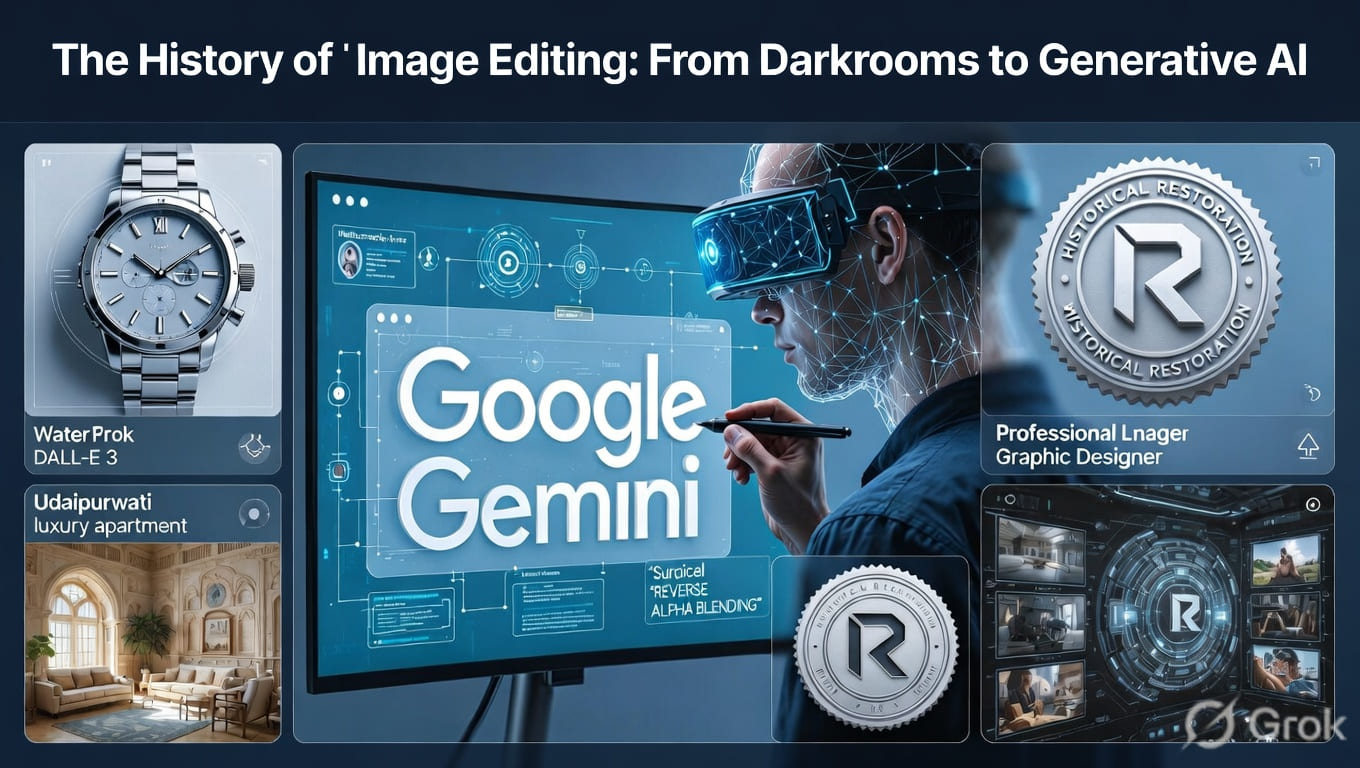
[Image showing a timeline from a 19th-century negative to a modern AI neural network interface]
5. Why Does History Matter for Today’s Creator?
Understanding the history of image editing helps us realize that AI is not “cheating”—it is an evolution. * Just as Le Gray combined negatives to fix the sky, we use AI to fix the watermarks.
- Just as Ansel Adams burned shadows for drama, we use AI to enhance clarity and resolution.
The tools change, but the mission remains: To reach the perfect version of our vision.
Conclusion: The Brick in the Digital Wall
At ReachBrick AI, we see ourselves as a part of this long history. We are the latest “Brick” in the wall of image technology. By providing a stable, browser-based foundation for cleaning AI art, we help you “Reach” the same professional standards that took Ansel Adams hours to achieve in a darkroom—all in under 5 seconds.