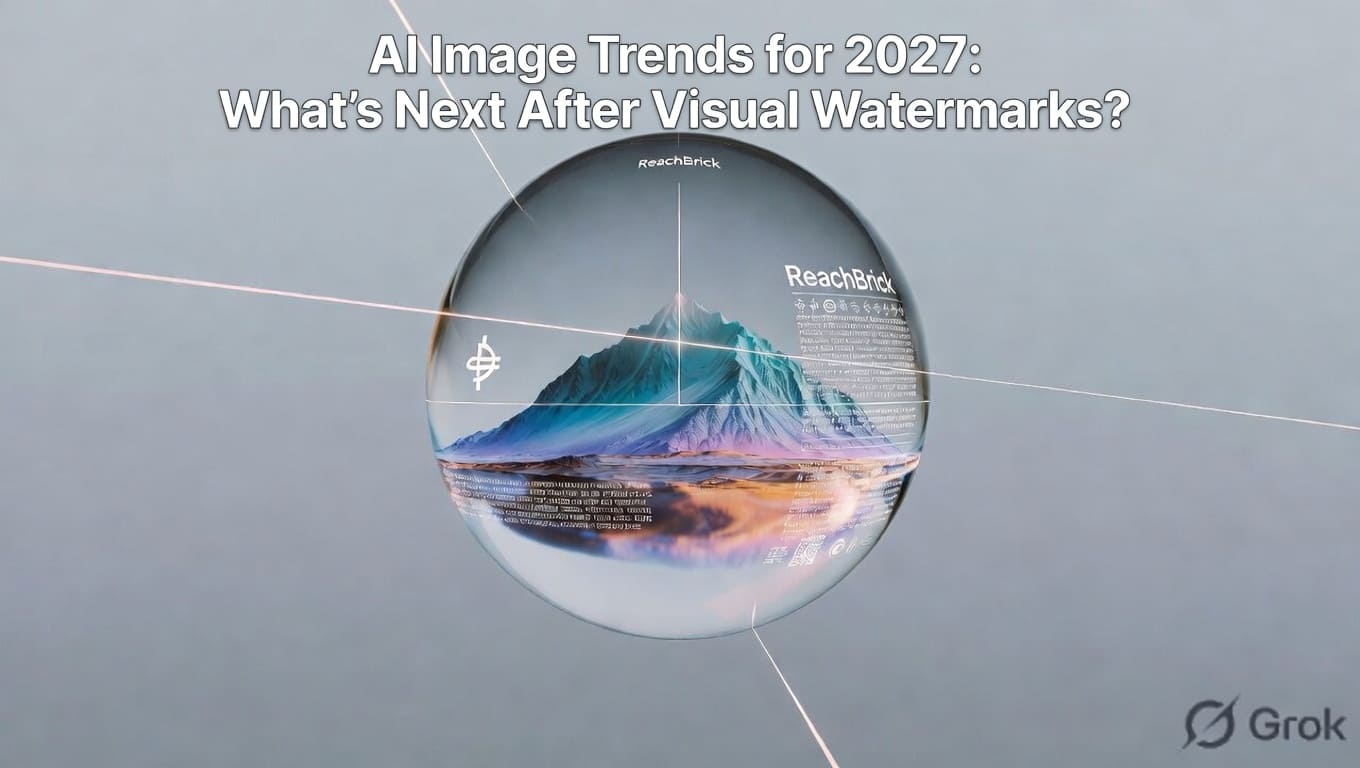
Introduction: The Shift from “Generation” to “Authenticity”
As we move toward 2027, the “Novelty Phase” of AI image generation is officially over. In 2024 and 2025, we were amazed that a machine could create a cat in a space suit. In 2026, we focused on cleaning those images for professional use. But in 2027, the trend is shifting toward “Digital Realism” and “Integrated Workflows.”
The “Too Perfect” look of AI is facing a backlash. Audiences are now craving visuals that feel human, flawed, and authentic. In this forward-looking guide, we explore the top 5 trends that will define AI imagery in 2027 and how ReachBrick AI is evolving to meet these new challenges.
1. Authenticity Over Perfection: The Rise of “Human Noise”
One of the biggest predictions for 2027 is the move away from the “Plastic AI Look.” Users are now engineering prompts to include “Film Grain,” “Light Leaks,” and “Asymmetrical Features.”
- The Trend: Images that look like they were captured on an old 35mm camera or a shaky smartphone are outperforming pristine 8K renders.
- ReachBrick’s Role: When you remove a watermark in 2027, you don’t just want a “smooth” patch; you want a patch that matches the intentional grain and flaws of the authentic-style AI art.
2. Multimodal AI Agents: The “Chain of Tools”
In 2027, you won’t just use one AI. You will use AI Agents that talk to each other.
- Example: You’ll ask an agent to “Design a marketing campaign,” and it will automatically use ChatGPT for the concept, Midjourney for the visual, and a tool like ReachBrick for the final cleanup—all in one automated chain.
- The Future: ReachBrick is moving toward API-First Integration, allowing these agents to “Call” our restoration engine automatically before delivering the final product to the user.
3. The Death of the Visual Watermark?
We are seeing a massive shift from “Visible Logos” to “Invisible Cryptographic Signatures.” Major platforms are facing pressure to stop “cluttering” the visual experience.
- The Prediction: By late 2027, the “Star” or “Text” watermark might disappear from the corner, replaced entirely by C2PA Metadata and Steganographic Signatures.
- Will ReachBrick still be needed? Yes. Even without logos, AI still leaves “Synthetic Artifacts” and “Prompt Glitches.” ReachBrick will evolve from a “Watermark Remover” into a “General Pixel Restorer” that cleans up AI-generated errors.
[Image showing a spectral analysis of an image where the visual logo is gone but the digital signature remains]
4. Surreal Silliness and Bold Experimentalism
As photorealism becomes “boring,” artists are pushing into Surrealism. Think “Photorealistic animals in impossible dreamscapes” or “Liquid architecture.”
- The Challenge: These complex images have intricate textures. Traditional “blur” tools fail miserably here. ReachBrick’s Mathematical Reconstruction will be more vital than ever to preserve these surreal details during the cleaning process.
5. Localized Edge AI: No More Uploading
Privacy laws in 2027 (like the EU AI Act) are becoming stricter. People don’t want to upload their private photos to a cloud server.
- The ReachBrick Advantage: Since our tool already runs in your browser’s local GPU, we are already ahead of the 2027 privacy trend. Your images stay on your device, making ReachBrick the safest choice for corporate and private data.
Conclusion: Reaching for 2027
The future of AI art is not about the tool; it’s about the Touch. As we move into 2027, the winners will be the creators who can combine AI power with human taste. ReachBrick AI will continue to provide the “Brick-solid” foundation, ensuring that as AI evolves, your ability to present clean, professional, and authentic work remains unchanged.